

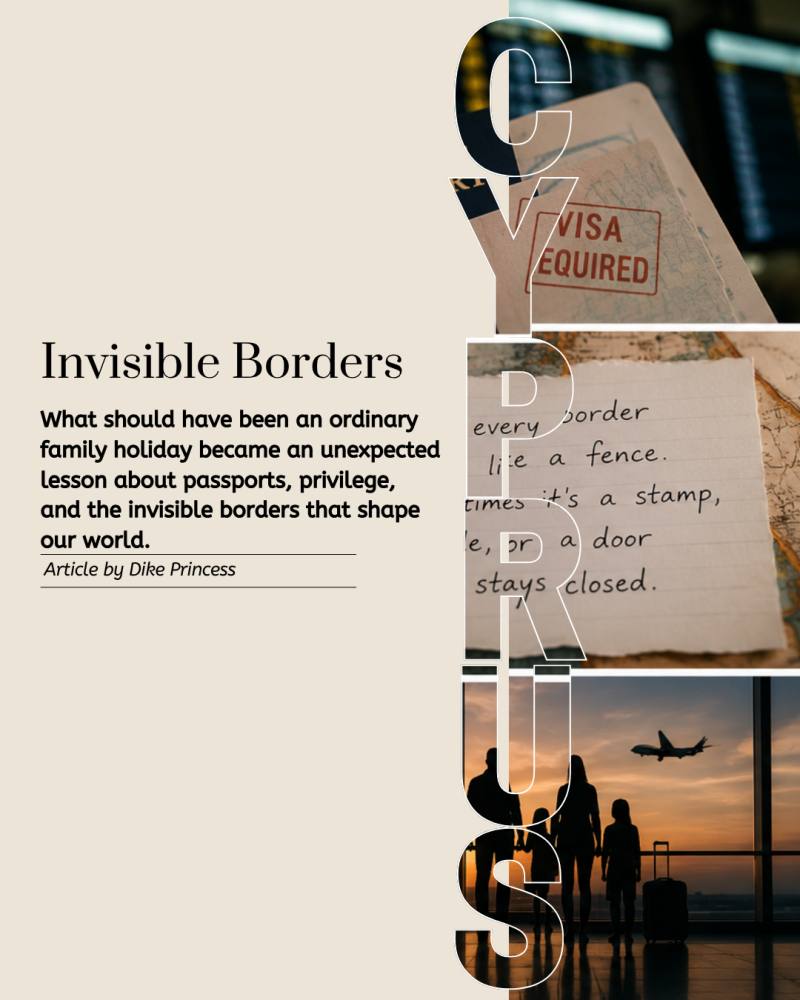
What should have been an ordinary family holiday became an unexpected lesson about passports, privilege, and the invisible borders that shape our world.
A family holiday was supposed to begin with sunshine, hotel check-ins, and the excitement of exploring somewhere new. Instead, it began beneath the harsh glow of airport lights, with cold metal benches replacing hotel beds and uncertainty replacing anticipation.
They expected to be unpacking their suitcases by evening.
Instead, they spent the night trying to sleep in an airport, wondering how everything had changed so quickly.
One unexpected visa requirement -just one- was enough to bring their journey to a halt. Having travelled to Cyprus before using their American visas, the family believed nothing had changed.
This time, however, the rules were different.
Without a Cypriot visa, they couldn't continue.
For the next three days, the airport became their temporary home. Metal benches replaced comfortable beds. Meals became a matter of affordability rather than choice, with chicken nuggets becoming a familiar option because nearby airport hotels and restaurants were simply too expensive. Even asking for help became a challenge as language barriers turned ordinary conversations into difficult exchanges. Google Translate quickly became one of the family's most valuable companions.
The uncertainty was exhausting.
But what stayed with them most wasn't the lack of sleep or the inconvenience.
It was the feeling that their journey was no longer defined by where they wanted to go, but by paperwork, immigration policies, and administrative decisions completely outside their control.
Eventually, their visas were approved.
The holiday continued. Photos were taken, memories were made, and life moved on.
Yet something had changed.
Those three unexpected days had quietly transformed the way they understood borders.
We often think of migration as something permanent, a decision to leave one country and build a life somewhere else. Yet movement across borders takes many forms. Sometimes it lasts a lifetime. Sometimes it lasts only a few days. Even brief moments of uncertainty can reveal how differently people experience the freedom to travel.
For some, crossing a border is little more than presenting a passport and waiting for a stamp.
For others, every journey depends on visa applications, changing immigration policies, lengthy security checks and the uncertainty of whether permission will be granted. The destination may be the same, but the journey is profoundly different.
This family's experience lasted only three days.
It cannot be compared with the hardships faced by refugees, asylum seekers or migrant workers, whose journeys are often marked by conflict, displacement, danger and years of uncertainty. Yet those three days offered a small glimpse into an important truth: borders are not experienced equally.
We often imagine borders as fences, checkpoints or walls.
Yet some of the most powerful borders are invisible.
They exist in passport rankings, visa requirements, immigration policies and administrative decisions that determine who moves freely and who must wait. They influence opportunities, shape lives, and quietly remind us that freedom of movement is not a universal experience but one that is experienced differently depending on where a person comes from and the passport they carry.
Sometimes, it takes an unexpected experience to challenge assumptions we never realised we held.
What began as a family holiday became an unexpected lesson in empathy, a reminder that the ability to travel, to belong and to move freely is something many people rarely have reason to question. In contrast, countless others must navigate obstacles long before their journey even begins.
Every day, millions of people encounter borders far more complex than a delayed holiday. Their stories rarely make headlines, yet they reveal how policies, paperwork, and circumstance shape human lives in ways many of us never see.
At THE WORLD & I, we believe every journey has a story worth telling because every story offers a new way of understanding the world.
Sometimes the greatest distance we travel is not across countries, but across perspectives. And sometimes, the journeys that change us most are the ones that teach us to see the lives of others with greater empathy than before.
Add comment
Comments